
Picture a snowy morning on I-91 with slush building in the travel lanes, or a Windham County dirt road that hasn't seen a plow yet. Every winter, drivers around here wonder which AWD system is best. This article explains how the Subaru Symmetrical AWD system compares to others in plain language. If you'd like to see these vehicles in person, you can browse our new Subaru inventory.
The short version: full-time, balanced AWD gives you a real, explainable advantage in traction and acceleration. It works best alongside good tires, regular maintenance and sensible driving.
How Subaru Symmetrical AWD Works
Subaru Symmetrical AWD is a full-time system, so it sends power to all four wheels at all times. Sensors monitor traction and vary power to match what each wheel needs.
The Straight-Line Layout and Boxer Engine Balance
The “symmetrical” name comes from how the system is arranged. Subaru mounts the engine and transmission lengthwise, in a straight line along the vehicle’s centerline, with nearly equal-length axle shafts on each side. Most competing crossovers mount the engine sideways (transversely), which puts more weight over one side and the front wheels, and often uses unequal-length shafts that can cause torque steer, a tug at the steering wheel under hard acceleration. Subaru’s balanced, in-line layout distributes weight more evenly side to side and helps keep steering feel predictable as power flows to all four wheels.
The Subaru BOXER engine plays a supporting role. Its cylinders are horizontally opposed, one set on each side of the crankshaft. That lets the engine sit low, which lowers the center of gravity and supports stability and responsiveness. The opposing layout also balances motion naturally, and the flat, symmetrical design minimizes vibration. A low engine helps balance, but grip has to come from somewhere else.
Full-Time Power Delivery and X-MODE
Subaru AWD is always on, since the drivetrain keeps all four wheels connected. That still doesn't mean a fixed split of power. The 2026 Outback, for example, constantly evaluates acceleration and braking, plus cornering, in real time. If a wheel slips, power transfers to the wheels with the most grip.
X-MODE works with Symmetrical AWD to increase traction and stability on slippery or steep terrain, and on uneven ground too, including snow, ice, mud and loose gravel. It optimizes throttle response and transmission behavior, along with wheel-specific torque. Hill Descent Control manages throttle and braking on descents while you steer. X-MODE is meant for difficult low-speed conditions. Don't treat it as a highway snow mode, and it won't stand in for winter tires.
Subaru Symmetrical AWD vs. Reactive and On-Demand AWD Systems
A vehicle carrying an AWD badge tells you little about how it engages both axles and manages changing traction. That is where Subaru AWD vs 4WD and other designs differ in philosophy. The table below compares the main system types in general terms.
| System Type | Power Delivery | Best Suited For | Typical Limitation |
|---|---|---|---|
| Subaru Symmetrical AWD | Full-time, power to all four wheels at all times | Changing surfaces on everyday roads | Still depends on tires and driver judgment |
| On-demand/reactive AWD | Normally front or rear drive, sends power to the other axle when sensors detect slippage or need for traction | Everyday driving with occasional traction needs | Capability varies with design and tires |
| Front-biased crossover AWD | Emphasizes everyday driving, adds rear power when front tires lose traction | Daily commuting with some added traction | Varies by model and software |
| Traditional 4WD | Driver-selected, often with locked differentials and high and low range | Rocky terrain, deep sand and steep inclines | Requires the driver to choose the mode |
Full-Time vs. On-Demand AWD
On-demand (part-time) AWD normally runs as front-wheel or rear-wheel drive. It automatically sends power to the other axle when sensors detect slippage or a need for more traction. Modern versions may anticipate demand using inputs like accelerator position, so not every system simply waits for wheelspin.
Subaru’s approach keeps both axles involved in propulsion all the time and adjusts as conditions change. Because power is already flowing to the rear wheels, there’s no momentary delay while the system detects slip and engages the other axle, which is the moment when a reactive system is most likely to let a wheel spin on ice or wet leaves.
What this means on your drive: When you pull away from a stop sign on a slushy Brattleboro hill, all four wheels are already working, instead of the system waiting for a front wheel to slip before reacting.
Subaru vs. Front-Biased Crossover Systems
Some crossovers lean toward front-wheel drive for everyday use and add rear power when needed. Honda's 2027 CR-V Real Time AWD is one example. It sends extra power to the rear wheels when it senses the front tires losing traction. That's one model's approach and doesn't describe every crossover.
Results depend on software, tires and vehicle setup. Comparing specific vehicles tells you more than comparing labels.
What this means on your drive: Ask how a specific model delivers power, then compare it with the one you're considering.
Subaru vs. Audi Quattro, BMW xDrive, Mercedes 4MATIC and Traditional 4WD
If you're weighing Subaru AWD vs Audi quattro, know that the name covers differing designs. Audi quattro automatically adjusts torque between the front and rear axles, and components vary by model. Most traditional quattro systems are full-time AWD. Some newer quattro ultra variants can temporarily decouple the rear axle under light driving and re-engage when needed. BMW xDrive and Mercedes 4MATIC are also brand names, so compare the exact model and year.
Typical 4WD is different again. The driver selects it, and it's usually paired with locked differentials, which lock both wheels on an axle together. It usually offers high and low range. Low range is meant for rocky terrain, deep sand and steep inclines.
What this means on your drive: For paved Vermont winter roads, the specific vehicle, its tires and its clearance matter more than the badge, so compare those.
How Symmetrical AWD Performs on I-91, Route 9 and Windham County Dirt Roads
These roads are useful context, and none of them is a formal test. Highway travel, hills and unpaved roads each ask something different of a vehicle. Match the technology to the driving you actually do around Brattleboro.
Snow, Black Ice, Mud and Unplowed Roads
On I-91, AWD can help manage propulsion when traction varies across wet pavement, snow or slush. It doesn't justify normal highway speeds when conditions worsen. On Route 9, grades and curves make smooth acceleration and generous following distance especially important.
On Windham County dirt roads, loose surfaces, mud and ruts mean uneven wheel traction. Low-speed traction management can help keep you moving, but road condition and ground clearance still set limits. Deep snow can pack beneath the vehicle, and an AWD vehicle can still get stuck.
Black ice may go unseen, and it can leave tires with very little grip. A few habits help in these conditions:
-
Use smooth inputs on the accelerator and brake, and when steering.
-
Leave extra following distance.
-
Slow down before turns, not during them.
-
Brake early and gradually.
What AWD Cannot Do: Braking and Cornering Limits
AWD helps a vehicle apply driving force. Braking and cornering depend on tire grip, surface friction and speed. NHTSA says it is harder to control or stop a vehicle on slick or snow-covered surfaces. Slow down and leave enough room to stop. Learn whether your vehicle has ABS and use it with firm, continuous pressure.
A few common myths are worth clearing up:
-
"AWD helps me stop faster." It doesn't.
-
"AWD lets me take corners faster on ice." Don't count on it.
-
"X-MODE means I can drive anywhere." Also false.
What this means on your drive: AWD helps you get going. How safely you stop and turn comes down to your tires and speed, plus your own judgment.
Winter Tires, Ground Clearance and Maintenance That Support AWD
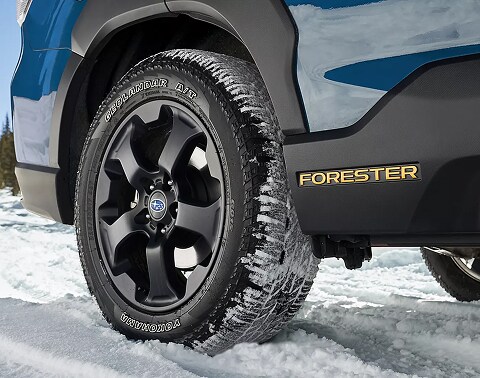
Subaru says AWD and 4WD vehicles should be equipped with snow tires for the best winter performance. NHTSA also advises considering snow tires and keeping tread at least 2/32 of an inch on all tires. Check your owner's manual for tire requirements for your exact vehicle.
Ground clearance helps with snow buildup and uneven roads, but it says nothing about traction. For 2026, the Crosstrek offers up to 9.3 inches. The Forester has 8.7 inches standard and the Forester Wilderness has 9.3 inches with standard 235mm all-terrain tires. The Ascent has 8.7 inches. Outback has 8.7 inches on all trims except the Wilderness, which has 9.5 inches.
Subaru Models with Symmetrical AWD
Equipment varies by model and trim across Subaru's AWD lineup, so it's worth confirming the details. Here are several popular choices for 2026.
| Model | AWD | X-MODE |
|---|---|---|
| Crosstrek (including Crosstrek Hybrid and Wilderness) | Standard Symmetrical AWD | Standard on all trims, with Dual-Function X-MODE and Hill Descent Control |
| Forester (gas, hybrid and Wilderness) | Standard Symmetrical AWD | X-MODE standard on Premium; Dual-Function X-MODE standard on Sport, Wilderness, Limited, Touring and all Hybrid trims (not on base) |
| Outback | Standard Symmetrical AWD | Standard on all trims; Dual-Function X-MODE standard on Wilderness |
| Ascent | Standard Symmetrical AWD | Standard on all trims; Dual-Function X-MODE standard on Limited and Touring |
An AWD Subaru Crosstrek and a Subaru Forester with Symmetrical AWD suit different needs, so match the vehicle to your passengers and your commute, and to the cargo you carry. You can browse our new Subaru inventory or look at pre-owned Subaru models.
Winter-Readiness Checklist for Your Subaru
Symmetrical AWD works best when the rest of your vehicle is ready for winter. Before the first storm rolls through Windham County, check these:
-
Tires, checked at least monthly and before long trips, including tread and sidewalls
-
Tire pressure, set to the level on the driver’s door-frame label and checked when cold
-
Fluids
-
Wipers
-
Battery
Our service center handles any make and model, and it’s a one-stop shop for tires, oil changes and tune-ups. Schedule a service appointment at Brattleboro Subaru before winter arrives.
Why Brattleboro Subaru Is Southern Vermont's All-Weather Expert
We'd rather explain than oversell. We serve Brattleboro, Keene NH, Northampton MA and broader New England, and we focus on two things.
First, a no-pressure, customer-focused buying experience. Second, transparent pricing, so you know where you stand. We'll explain both what AWD can do and where it stops, including when winter tires matter more than the drivetrain.
Test Drive a Symmetrical AWD Subaru at Brattleboro Subaru Today
A test drive is the best way to feel how Subaru Symmetrical AWD compares to other systems on your own routine. Notice the balanced, predictable steering as you accelerate, and check visibility, seating, ride comfort and cargo access while you’re at it. Our team can walk you through X-MODE and the tire options that pair best with Subaru AWD for Vermont winters.
Find us at 1234 Putney Rd, Brattleboro, VT 05301, or call sales at 833-349-6615. Sales hours are Monday to Thursday 9 AM to 7 PM, Friday 9 AM to 6 PM and Saturday 9 AM to 5 PM. When you're ready, schedule a test drive.


